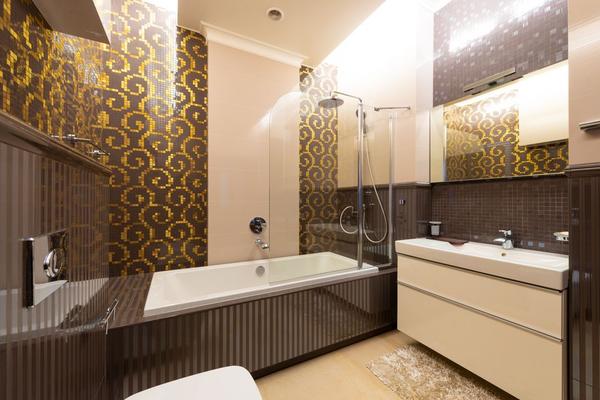

Tile size changes more than the look of a bathroom. It affects where grout lines fall, how many cuts an installer makes, and whether a surface can accommodate slopes, corners and fittings. The biggest tile in the showroom is not automatically the best choice.
This bathroom tile sizes guide starts with the surfaces you need to cover, then works backwards to formats that make those surfaces easier to finish. A compact bathroom can suit large tiles, while a spacious one may benefit from mosaics in the right place.
Choose by Surface, Not Just Room Size
Before comparing bathroom tile dimensions, separate your project into shower floor, main floor, shower walls and other walls. Each has different demands. A straight wall offers room for broad tiles; a shower floor with a central drain needs tiles that accommodate slopes towards it.
Look at awkward details too: the strip beside the vanity, a recessed niche or a short wall behind the toilet. These often determine whether a format looks deliberate or leaves distracting slivers.
Small, Medium and Large Tile Formats
Small Tiles: Detail and Flexibility
Small bathroom tiles include mosaics around 25–50 mm across and individual 100 × 100 mm squares. Their many joints help them follow complex shapes and multi-directional shower-floor slopes. They can also make a niche or splashback a focal point.
The trade-off is grout. More joints create a busier appearance and more lines to clean. Mesh-backed mosaics speed placement, but sheet boundaries may show if spacing is inconsistent. A floor mosaic still needs suitable wet-area slip resistance; small size alone does not guarantee grip.
Medium Tiles: A Versatile Middle Ground
Formats such as 200 × 200 mm, 300 × 300 mm and 300 × 600 mm balance manageable handling with fewer grout lines. They often work well on bathroom floors and walls with several interruptions.
A rectangular tile laid horizontally can emphasise width; vertically, it may draw the eye upwards. Test both orientations at the actual wall rather than relying on product photographs.
Large Tiles: Calm Surfaces, More Planning
Large bathroom tiles commonly include 600 × 600 mm and 600 × 1200 mm formats, although manufacturers define ‘large format’ differently. With fewer divisions, they create a calmer surface, even in small bathrooms when grout closely matches the tile.
Large tiles demand a sufficiently flat, stable substrate and careful handling. Uneven backgrounds increase the risk of lippage, where one tile edge stands proud of another. Large offcuts may be difficult to reuse around plumbing, increasing waste and labour.
Grout Lines Change the Whole Effect
Tile format and grout spacing belong in the same decision. Small tiles create more joints; larger tiles generally create fewer. Contrasting grout turns them into a visible grid, while a close colour match unifies the surface.
Rectified tiles cannot simply be installed with no gap. Even precisely cut tiles need suitable joints, whose width depends on size variation, edge profile, surface conditions and manufacturer instructions. The Tile Council of North America explains that spacing must account for differences between individual tiles, not only appearance.
Grout is not waterproofing. Showers need a suitable waterproof assembly behind or beneath the tiled finish. Consider how to choose grout colour while selecting tiles rather than after installation starts.
Where Different Sizes Work Best
Shower Floors and Drains
A shower floor pitched from several directions to a point drain usually works best with small tiles or mosaics, which follow changes in angle. A floor pitched on one plane towards a suitable linear drain can accommodate larger formats when the whole assembly is designed correctly.
Confirm the tile’s intended floor use, slip resistance, drainage and waterproofing before ordering. A large wall tile is not automatically suitable for a wet floor.
Main Floors and Walls
On an open floor, 300 × 600 mm or 600 × 600 mm tiles can reduce visual clutter. In an irregular room, smaller formats may mean fewer complicated cuts. On walls, 300 × 600 mm tiles provide a useful compromise between intricate patterns and a slab-like finish.
Large wall tiles look effective across uninterrupted shower walls, but check how edges meet niches, taps and ceilings. Review bathroom tile layout patterns before selecting the final dimensions.
Draw a Cut Plan Before Ordering
Imagine a bathroom wall approximately 1700 mm wide and a tile measuring 600 mm across. Two full tiles occupy 1200 mm, leaving roughly 500 mm before allowing for grout. A centred layout might create two edge pieces of about 250 mm; starting with a full tile could leave one 500 mm cut at the other end.
Neither layout is universally correct. The better choice depends on visible edges, shower screens and fittings. Draw both to scale, including grout joints. Actual tile dimensions can differ slightly from nominal packaging sizes.
Ask your installer to assess the floor and wall flatness, the narrowest cuts, the shower slope, and how corners and movement joints will be finished. Order extra material appropriate to the layout and cutting complexity.
Size Mistakes That Can Spoil a Good Design
Choosing large tiles solely to make a room appear bigger is one mistake. Broad surfaces can look elegant, but thin strips around a doorway may spoil the effect. Using tiny mosaics everywhere is another: a repeated grid can overwhelm a bathroom intended to feel calm.
Also check actual thicknesses and edge finishes when mixing formats. Coordinated colours do not guarantee matching product dimensions. Planning bathroom wall and floor tile combinations early helps avoid awkward transitions and trim details.
Frequently Asked Questions
What is the best tile size for a small bathroom?
There is no single best size. Medium tiles are adaptable, while large tiles can look spacious if the layout avoids narrow cuts. Choose based on wall lengths, floor shape and drainage.
Do larger bathroom tiles make a room look bigger?
They can make surfaces feel less busy through fewer grout lines. Lighting, colour and the size of edge cuts also affect the impression.
Are small tiles better for shower floors?
Often, particularly with shower bases sloping towards a point drain. A properly designed single-slope shower with a linear drain may accommodate larger tiles.
Can bathroom tiles be installed without grout lines?
No. Joints accommodate manufacturing variation and installation conditions. Rectified edges create a consistent appearance but do not eliminate the need for spacing.
Choose the Format That Makes the Layout Work
The most successful tile size suits the surface, balances cuts and supports sound installation. Start with drainage and real wall measurements, then compare small, medium and large formats on a drawn layout. Once practical decisions are settled, colour and pattern become easier to choose confidently.