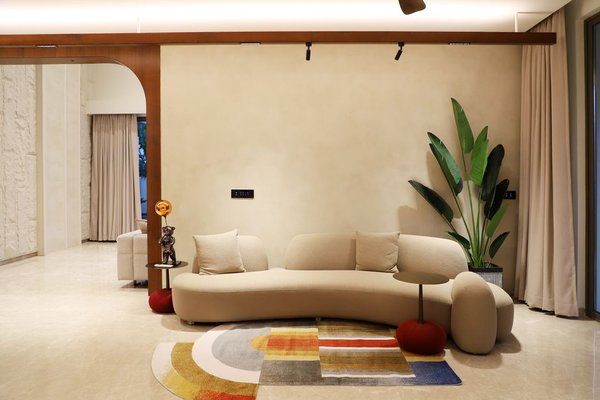

Curved sofas have moved from designer showrooms into the mainstream, becoming one of the most recognisable furniture shapes in 2026 UK interiors. After years of rigid modular seating and boxy silhouettes, a rounded sofa brings softness, movement and a more relaxed mood to the living room.
The key is to treat the sofa as part of the room rather than an isolated statement. Successful curved sofa styling balances shape, scale, circulation and texture, allowing the piece to become a living room centrepiece while the rest of the scheme supports it.
Why the curved sofa trend feels right for 2026
The wider sculptural furniture trend is not simply about replacing straight lines with rounded ones. It reflects a shift towards interiors that feel warmer, more tactile and easier to live in. Sofas with sweeping backs, rounded arms and gently arched bases create visual flow, making a room feel less formal and more welcoming.
Curved seating can also change how people use a space. A conventional sofa often faces one direction, usually towards a television or fireplace. A curved design turns seats slightly towards one another, encouraging conversation. In an open-plan home, its silhouette can define the sitting area without creating a hard visual barrier.
The look is not entirely new. Mid-century designers used serpentine and crescent-shaped seating decades ago. What makes the 2026 interpretation feel current is the emphasis on comfort, practical upholstery and softer, less theatrical proportions.
Choose a curve that suits the room
Not every curved sofa is a dramatic semicircle. Some models have only a gently bowed back, rounded corners or flared arms. These quieter shapes are easier to place in typical UK living rooms.
For compact living rooms
Look for a two- or three-seat sofa with a shallow arc and raised legs. Visible floor beneath it helps the room feel lighter, while the softened outline reduces the harshness of tight corners. Measure the sofa at its deepest point, not just across the front, and mark the footprint with masking tape before ordering. Related reading: small living room layout ideas.
For larger or open-plan spaces
A deeper crescent or modular curved sofa can create a complete seating zone. Position it away from the wall so the shape can be appreciated from several angles. Space behind it also preserves a clear route through the room.
Let the sofa lead without overpowering everything
The strongest statement sofa ideas usually begin with restraint. Once the sofa provides the main sculptural shape, surrounding furniture should complement it rather than compete. An oval coffee table, round side table or softly shaped rug can repeat the curve, but using rounded forms everywhere may make the room feel overly themed.
Combine one dominant curve with straighter architectural elements. For example, place a cream crescent sofa in front of simple fitted shelving, then add a rectangular rug and one circular coffee table. The contrast keeps the room balanced.
Consider sightlines too. A high-backed curved sofa can block a window or interrupt the view across an open-plan room. A lower profile works better when the piece sits centrally, while a taller design can feel reassuring and cocooning against a wall.
Build a colour palette around the silhouette
Neutral upholstery allows the form to do the talking. Oatmeal, warm ivory, mushroom and soft taupe give curved furniture a calm, architectural quality. These shades also work well with warm woods, clay tones and muted greens.
A curved sofa does not have to be pale. Olive velvet, rust, tobacco, deep blue or burgundy can turn it into a true focal point. In a smaller room, repeat the sofa colour once or twice in modest details, such as a lampshade, artwork or cushion piping. This makes the choice feel intentional. Related reading: colour drenching technique.
Use texture to make the shape inviting
Curved sofas are often shown in bouclé, but it is not the only option. Chenille gives a soft, family-friendly finish, velvet adds depth, and tightly woven performance fabrics suit busy homes. Linen-look upholstery suits relaxed schemes.
Keep cushions edited. Too many square cushions hide the sofa’s defining line. Two or three in mixed shapes are usually enough, perhaps one long lumbar cushion and two smaller, softly filled designs. Add a throw over one end rather than covering the entire back.
A textured rug helps ground the sofa, especially when it floats in the room. Choose one large enough for at least the front legs to sit on it. A rug that stops short can make the sofa look disconnected. Related reading: furniture placement rules for small living rooms.
A real-world layout that works
Imagine a 4-by-5-metre UK living room with a bay window, fireplace and television fitted into an alcove. Instead of pushing a curved sofa against the longest wall, place it slightly forward and angle the open side towards the fireplace. Use a slim oval coffee table that follows the arc, then position one compact armchair near the bay window.
This creates a conversation area without blocking the television. A narrow console behind the sofa can hold a lamp and provide a visual transition to the doorway. Keep a clear walkway of roughly 75 to 90 centimetres where people regularly pass, adjusting for the room’s proportions and the needs of the household.
Lighting and accessories for a sculptural finish
Curved furniture looks best when light reveals its outline. A floor lamp with an arched stem can echo the sofa subtly, while a shaded table lamp adds softer pools of light in the evening. Avoid making every accessory symmetrical. A slightly off-centre lamp, artwork or side table makes the composition feel more natural.
Choose artwork with enough visual weight to hold its own above the sofa. One large piece often works better than a busy gallery wall when the seating already has a strong silhouette. A few sculptural ceramics can complete the room without clutter.
Frequently asked questions
Are curved sofas suitable for small living rooms?
Yes, provided the curve is gentle and the depth is measured carefully. Compact models with raised legs and rounded corners can soften a small room without consuming excessive floor space.
Should a curved sofa sit against a wall?
It can, but most designs look better with a little breathing room behind them. Even a small gap helps reveal the outline and prevents the sofa from appearing squeezed into place.
What coffee table works with a curved sofa?
Oval, round and organic-shaped tables usually follow the sofa’s flow well. A slim rectangular table can also work when the room needs contrast, provided its corners do not obstruct movement.
Will curved sofas date quickly?
A highly exaggerated shape may feel more trend-led, but a gently curved sofa in a durable fabric has lasting appeal. Its design roots also give it lasting context.
Make the curve feel personal
The curved sofa living room trend works best when it supports everyday life rather than becoming a piece that must be styled perfectly. Choose a shape that fits the room, protect comfortable walking routes and let the sofa provide the main visual gesture. With thoughtful colour, restrained accessories and a mix of curved and straight lines, it can feel sculptural, welcoming and entirely at home long after 2026.