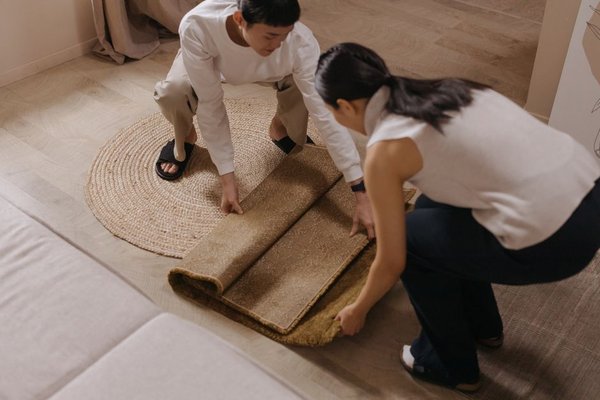

Choosing a living room rug should be straightforward, but many online size guides are written in feet and inches while UK retailers usually sell rugs in centimetres. The easiest method is to measure your seating area in centimetres, decide how much furniture should sit on the rug, then match those measurements to the nearest common UK size.
A well-sized rug connects the sofa, chairs and coffee table. Too small, and the furniture can look disconnected. Too large, and you may lose the visible flooring that helps frame the room. The right size depends largely on the footprint of the seating group.
Common living room rug sizes in the UK
There is no single official list of rug sizes UK retailers must follow, and dimensions vary by brand. Around 120 x 170 cm suits a compact room or coffee-table rug. About 160 x 230 cm is versatile for many small to medium lounges. A 200 x 290 cm rug works with larger seating groups, while 240 x 340 cm, 250 x 350 cm or above suits generous rooms and open-plan spaces.
Treat these as shopping ranges rather than rigid standards. A 200 x 300 cm rug can perform much the same role as a 200 x 290 cm rug if the furniture placement works.
How to work out what size rug for your living room
Measure the room first, then measure the seating zone separately. Take the width and depth from the outer edges of the sofa and chairs that visually belong together. This gives you a realistic footprint to compare with available rugs.
In many layouts, the rug should extend beyond the coffee table and reach beneath at least the front legs of the main seating. Where space allows, roughly 20 to 30 cm of rug showing beyond the sides of the sofa is a useful starting point.
Before ordering, mark the proposed dimensions on the floor with low-tack masking tape. This is helpful when choosing between 160 x 230 cm and 200 x 290 cm because the difference can completely change the room’s balance.
Three practical rug placement rules
Front legs on the rug
This is often the safest arrangement for a typical UK lounge. Place the front legs of the sofa and armchairs on the rug while the rear legs stay on the floor. It connects the seating without demanding an oversized rug. A 160 x 230 cm rug may suit a compact arrangement, while 200 x 290 cm gives more breathing room.
All furniture legs on the rug
In a larger room, placing the entire sofa and chairs on the rug creates a more unified seating zone. The rug should extend beyond the furniture rather than ending directly under the back legs. This usually calls for a larger size, often around 200 x 290 cm or above.
A smaller floating rug
A small rug can sit beneath a coffee table without touching the seating, but it needs to look intentional. This works best in very compact rooms. If there is a wide gap between the rug and every seat, the rug may make the room feel smaller.
What works in a bay-window living room
A bay window makes the room shape less regular, but the rug does not need to copy the bay. It usually looks cleaner to centre a rectangular rug on the main seating arrangement and let the bay remain a separate architectural feature.
For example, imagine a lounge measuring roughly 3.6 x 4.2 metres with a three-seat sofa on the long wall and two chairs angled towards it. A 160 x 230 cm rug may connect the coffee table and front furniture legs without pushing into the bay. If the chairs sit farther apart, moving up to around 200 x 290 cm can make the group feel more cohesive.
Check door swings, radiator positions and the main walking route too. A rug can be the correct size on paper but awkward if its edge catches a door or narrows a busy path.
How to size a rug in an open-plan lounge
In an open-plan room, the rug should define the living zone rather than cover the entire floor. Measure the sofa, chairs and coffee table as one furniture island, then choose a rug large enough to anchor that group. This creates a visual boundary between the lounge and nearby dining or kitchen areas.
A common mistake is buying according to the total room dimensions. A 200 x 290 cm or 240 x 340 cm rug may be enough to define a substantial seating area even when the overall room is much larger.
For related planning, see our living room layout ideas, choosing flooring for living rooms, and mixing living room colours and textures guides.
Leave enough visible floor around the rug
Most rooms benefit from some visible flooring around the rug, but there is no universal border measurement. A compact lounge may look better with a relatively narrow border, while a larger room can handle more exposed floor. Avoid a rug that is almost wall-to-wall but leaves only a thin, uneven strip around the edge.
Check the rug orientation before buying
Most rectangular rugs work best when their longer side follows the main sofa or seating group. In a long lounge, that usually means running the rug lengthways. With a wide corner sofa, turning it across the room may look better. Mark both orientations with tape before buying.
FAQ
Is a 160 x 230 cm rug big enough for a living room?
It often is for a small to medium lounge where the front legs of the sofa and perhaps the chairs sit on the rug. For a wide sofa, corner sofa or larger seating group, 200 x 290 cm or above will usually feel better proportioned.
Should a living room rug go under the sofa?
Usually, yes. Having at least the front sofa legs on the rug helps connect the furniture visually. In larger rooms, placing the whole sofa on the rug can create a stronger seating zone.
How far should a rug extend past the sofa?
There is no compulsory measurement, but around 20 to 30 cm beyond each side of the sofa is a useful starting point. Adjust that according to room width, nearby furniture and the sizes available from your chosen retailer.
What rug size is best for an open-plan living room?
Choose according to the seating zone, not the full room. The rug should comfortably anchor the sofa, chairs and coffee table. For many larger arrangements, 200 x 290 cm, 240 x 340 cm or a similar large format works well.
Choose the rug from the furniture outward
The simplest approach is to start with the furniture arrangement rather than the bare floor. Measure the seating zone in centimetres, decide whether you want front legs or all legs on the rug, then compare that footprint with common retailer sizes. For many UK homes, the choice comes down to whether 160 x 230 cm is enough or whether around 200 x 290 cm gives the room better balance. Tape the dimensions on the floor, check walkways and doors, and choose the rug that makes the furniture feel connected.